|
|
|
||
|
Your Source
for Hand-woven Ethnic Doll Cloth that fit American Girl™
|
|||
| ||||||||
|
Guatemalan
Mayan Textiles and Traje
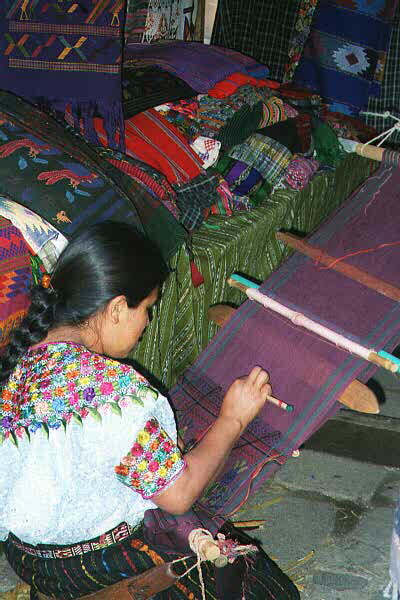
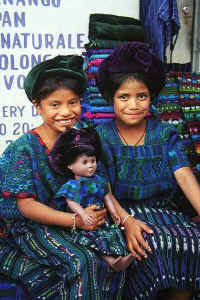
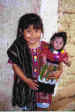
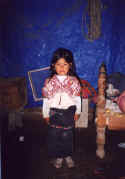
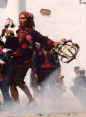
(Dress) For Mayan women from the highlands of Guatemala, the Traje (traditional dress) is a statement of her cultural and personal identity. Through her weavings she has an important role in both clothing her family and keeping the threads of the Mayan culture and cosmos together. Each Maya village has its own style of weaving and dress so you can usually tell which village a women is from the style of her traje. The traditional loom is the back-strap loom, a portable loom (see
picture) that a woman can easily move as she conducts her household chores, watches her
children or meets with friends at the market. The loom is made of 5 essential sticks with
one end fastened to a pole or tree and a woman creates the tension for the loom by the
belt or back-strap she wears around her waist. The Europeans brought the treadle or
foot- loom to Guatemala in the 15th century and it is usually
the men who weave cloth for skirts and export on it.
Essential elements of a woman’s dress are the huipil (blouse), corte (skirt), and faja (belt). The huipil (blouse) is usually hand-woven on a back-strap loom. It is likely to take several months to make with a woman weaving 3 to 4 hours each day among her other tasks. The fabric for the corte (skirt) is generally made by men on a treadle-loom and then pieced together by a woman for her own use. Many of the skirts have ikat patterns woven into the textiles. Other skirts, sometimes called morga, are dark blue, once made from indigo, but now from commercial dyes. The faja (belt or sash) is both decorative and functional, holding up the often tube-shaped skirt. The wider faja also provides additional strength as a woman carries her babies and heavy loads on her back. The tzutes (all-purpose utility cloths) is another important textile. Tzutes are variable in size and function – they carry goods and babies, cover the head against the sun or the shoulders for warmth, keep tortillas warm or are worn on the arm as a decorative accessory. Many traje also include a cinta (head scarf) and rebozo or perraje (shawl). Many Mayan women choose to weave and wear the traditional traje even though it is more expensive than commercially available alternatives. The traje is also more durable, and a woman may wear it for many years, weaving a new one to recognize major life transitions or when resources permit. |
| ||||||||||||
.jpg)





 To view traje and scenes from different
villages click on the pictures on the left of this screen.
To view traje and scenes from different
villages click on the pictures on the left of this screen.